
Obituary of Syed Nazir Rizvi
December 1, 1929 – July 19, 2026
It is with profound sadness and deep gratitude for a life of extraordinary purpose that the BC Provincial Executive Committee, Communist Party of Canada announces the passing of Syed Nazir Rizvi, who died peacefully on July 19, 2026, at the age of 96.
Born on December 1, 1929, in the village of Mustafabad near Allahabad, Uttar Pradesh, India, Nazir was raised in a family that held education in the highest esteem. Originally destined for a career in the Shia clergy, his inquisitive mind led him instead toward science, history, and a lifelong search for justice. As a young man he challenged conventional beliefs, attended an English language school against his father’s wishes, and eventually left India in 1951 to continue his studies in London.
His years in Britain proved transformative. Studying history at the University of London, Nazir came under the influence of distinguished Marxist historian Professor Eric Hobsbawm and became deeply engaged in the study of colonialism, class struggle, and world history. His intellectual development, together with the guidance of mentors in Britain’s progressive movement, shaped the convictions that would guide the remainder of his life: a steadfast commitment to socialism, internationalism, anti racism, and peace.
After completing his education, Nazir dedicated himself to teaching. His career took him first to Birmingham, England, and then to Nigeria in 1960 during the country’s historic transition to independence. There he taught history and teacher education while witnessing firsthand the struggles against colonialism and apartheid that further strengthened his commitment to African liberation and human dignity. It was at this time that he met renowned African revolutionary Dr. Frantz Fanon who introduced Nazir to the newly victorious Cuban revolution and was an inspiration that changed the direction of his life.
Nigeria also brought the greatest joy of his personal life. It was there he met fellow educator Krishna Syal, an accomplished educational psychologist whose intellect, compassion, and shared ideals made them lifelong partners. They married in Ibadan and consciously devoted their lives not to raising a family of their own, but to the broader cause of education, social justice, and human emancipation. Nazir often spoke about how Krishna was very firm in her rights as a woman and before marriage, ensured that he had a full understanding of her principles and conditions that would be the basis of their life-long relationship. Their partnership became one of shared purpose, mutual respect, and unwavering devotion for more than sixty years.
Health concerns eventually brought Nazir and Krishna to Canada in 1964, where they settled first in Halifax, Nova Scotia. As an educator and Head of the Social Studies Department at Graham Creighton High School, Nazir became a pioneering advocate for the inclusion of African and Black history in Nova Scotia’s curriculum. He worked tirelessly against racism, collaborating with Black educators and community organizations while helping establish one of the province’s earliest senior high school courses in African history. His efforts earned him the admiration of colleagues, students, and the black community. It was an historic accomplishment.
Following retirement in 1988, Nazir and Krishna relocated to British Columbia, where a new chapter of activism unfolded. For more than three decades he became one of Canada’s best-known advocates of friendship and solidarity with Cuba. As President of the Canadian Cuban Friendship Association (Vancouver) until his passing, he guided humanitarian campaigns during Cuba’s difficult “Special Period,” organized fifteen solidarity delegations, helped coordinate medical and educational aid, and helped strengthen and expand Canada’s coast-to-coast-to-coast Cuba solidarity movement. Nazir was a founding member of the Canadian Network on Cuba, a cross-Canada organization uniting all Canadian Cuba solidarity organizations.
Nazir joined the Communist Party of Canada while in Halifax and remained an active member the remainder of his life, serving in numerous leadership positions at local, provincial and federal levels and as a long-standing member of the Party’s Central Committee, several times representing the Party internationally. His lifelong commitment to an anti-imperialist world peace movement also found expression through his work with the Canadian Peace Congress and the Vancouver and Fraser Valley Peace Councils, where he campaigned tirelessly for nuclear disarmament, international cooperation, and a more peaceful world.
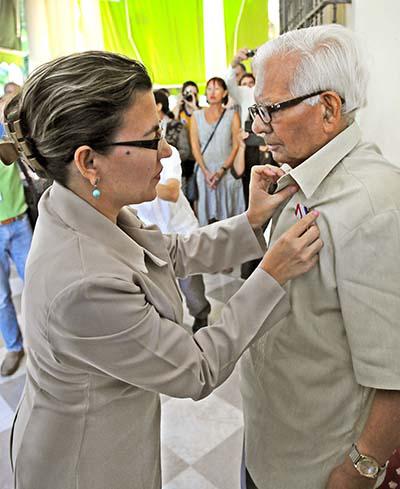
One of the defining moments of his life came in 1996 when he was invited to meet Cuban President Fidel Castro during Castro’s brief visit to Vancouver. Recognized by Castro as a fellow comrade, Nazir regarded the meeting as one of the greatest honours of his life. In 2015, during one of his trips to Cuba, he was awarded the Friendship Medal from the Cuban Council of State in recognition of decades of dedicated international solidarity, a distinction he characteristically insisted belonged not to himself alone, but to the many comrades with whom he had worked.
Nazir’s life was distinguished not by the pursuit of personal recognition but by an unwavering belief that education could liberate, that solidarity could overcome injustice, and that ordinary people possessed the power to build a more humane world. Whether teaching students in Britain, Nigeria, or Canada, standing beside movements against racism and apartheid, or supporting struggles for peace and international cooperation, he remained guided by the same principles throughout nearly a century of extraordinary social change.
In 2021, Nazir lost Krishna, the love of his life and partner in every endeavour. Though he mourned her deeply, he continued the work they had built together, remaining active in peace campaigns, Cuba solidarity, and community life well into his nineties. He often reflected that the years they spent together were the most meaningful of his life.
He is survived by countless friends, comrades, former students, colleagues, and activists across Canada and around the world whose lives were enriched by his wisdom, kindness, generosity, and unwavering integrity. His influence lives on in the movements he helped build, the educational reforms he inspired, and in the many people whose lives were touched by his example.
Nazir Rizvi believed that history belonged not merely to those who witnessed it, but to those willing to shape it through courage, compassion, and collective action. His life stands as a testament to those ideals. In honouring his memory, we celebrate not only an educator and activist, but also a remarkable human being whose lifelong commitment to justice, equality, peace, and international friendship leaves an enduring legacy for generations to come.
Rest in peace, Comrade Nazir. Your life’s work continues in all who strive for a more just and
peaceful world.