
Originally published in People’s Voice.
Nearly 61,000 registered, psychiatric and licensed practical nurses in BC have made their voices clear, forcefully and in unison, that they deserve a fair contract.
Between May 8 and 11, nurses who are party to the sectoral Nurses’ Bargaining Association (NBA) Provincial Collective Agreement held a strike vote. The majority of nurses covered by the NBA are represented by the BC Nurses Union (BCNU), with others represented by the Health Sciences Association, the Hospital Employees’ Union, and the British Columbia General Employees’ Union.
Fifty thousand nurses in the BCNU, working in BC hospitals, public health, home support, long-term care, and mental health care, voted in favour of job action, delivering a clear message to the provincial government and to the Health Employers Association of BC (HEABC). An overwhelming 98.2 percent voted in favour of job action.
On May 24, they reached a tentative agreement which includes improvements to benefits coverage, a wage increase of 12 percent over 4 years, workplace safety and violence prevention measures. The new deal, which will be voted on from June 15 – 19, also includes an agreement with the Ministry of Health for significant additional funding to continue implementing minimum nurse-to-patient ratios.
Nurses’ demands across the province’s six health authorities and affiliate organizations are clear: to be treated with the respect they deserve. Ahead of the strike vote, the HEABC had rejected 94 percent of the NBA’s 140 proposals including key initiatives related to wages, workload, workplace violence and occupational health and safety.
Nurses are fighting for improved nurse-to-patient ratios, increased recruitment and stronger workplace safety measures.
The BCNU reports that, since 2019, injury claims across the healthcare field have risen by nearly 25 percent, and psychological injuries have tripled.
As Adriane Gear, BC Nurses’ Union President and Chair of the NBA provincial bargaining committee, stated: “[Nurses] are prepared to fight for the future of nursing and for a healthcare system that is safe, sustainable and able to retain the nurses that patients rely on.”
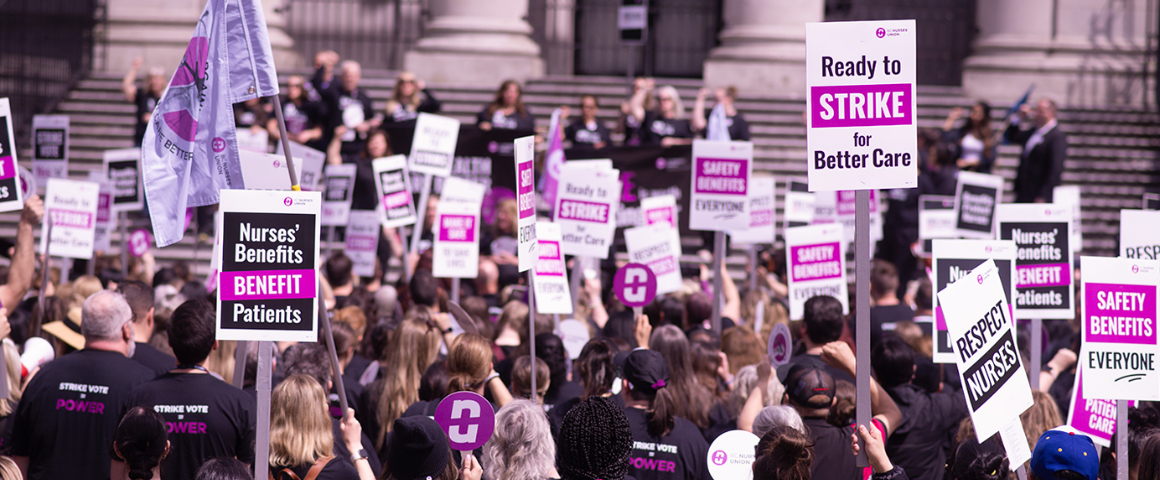
And fight they have, both at the bargaining table and on the streets. On April 30, over 500 nurses, allied healthcare workers and supporters rallied in downtown Vancouver to send a message ahead of the strike vote that nurses and labour stand in solidarity on the frontlines of the healthcare crisis in Canada.
Emergency departments in rural communities have faced temporary closures, and maternity and pediatric units in both rural and urban areas are reaching their boiling point. This is no accident: the provincial government is deliberately manufacturing a healthcare crisis to clear the way for two-tier, for-profit medicine. Hot on the heels of a government that is driving healthcare into the ground and toward a public-private model, BC Nurses have raised a red flag.
At the forefront of this fight is the expansion of minimum nurse-to-patient ratios. On February 17, the BCNU responded strongly to cuts announced in the BC Budget, which included pausing the expansion of long-term care facilities, increasing the strain on overwhelmed long-term care providers and the nurses employed at these facilities.
Nursing vacancies from Victoria to Fort St. John have ballooned to over 4,500 with, as the BCNU expressed, “tens of thousands more nurses needed in the coming years.” Not just staffing concerns, nurse-to-patient ratios impact the health and wellbeing of every British Columbian.
“Not only do minimum nurse-to-patient ratios improve the working conditions of nurses; they also ensure patients receive the safe care they deserve,” said Gear. “Nurses are the eyes and ears of healthcare.”
With the strike mandate secured, the BCNU and its partners in the NBA wasted no time. On May 14, they returned to the bargaining table with the HEABC, their 98.2 percent mandate serving as the central leverage point in their push for meaningful progress. The union held a 90-day window to engage in various forms of job action, from refusing to perform non-nursing duties such as handing out meal trays and cleaning stretchers, to a full-scale withdrawal of services.
The historic near-unanimous strike mandate meant that the NBA returned to the bargaining table holding the most militant show of unity in recent memory. With nurses signaling they were ready to escalate, the HEABC and provincial government were compelled to make meaningful movement on the key issues of nurse-to-patient ratios, wages and workplace safety.
Whatever the outcome of the ratification vote, BC nurses have made it clear: the status quo is no longer an option.